
What Is Coffee? A Simple Guide to Coffee Beans, Flavor, and Modern Brewing
What Is Coffee?
Coffee is a beverage made by extracting flavor and aroma from roasted seeds of the coffee plant. Those seeds are commonly called coffee beans, but botanically they are found inside the fruit of the coffee tree. The fruit is known as a coffee cherry.
The journey from coffee cherry to brewed coffee involves several important stages: cultivation, harvesting, processing, drying, roasting, grinding, and brewing. Each stage influences the final cup, including its aroma, acidity, body, sweetness, and bitterness.
Coffee can be prepared in many forms, from a carefully brewed pour-over to a convenient instant coffee serving. At Tap Labs, we believe great coffee should preserve the character of the bean while fitting naturally into modern routines—whether that means brewing through a bottle cap, dissolving a coffee card, or enjoying coffee in a compact candy format.
What Is Coffee Made Of?
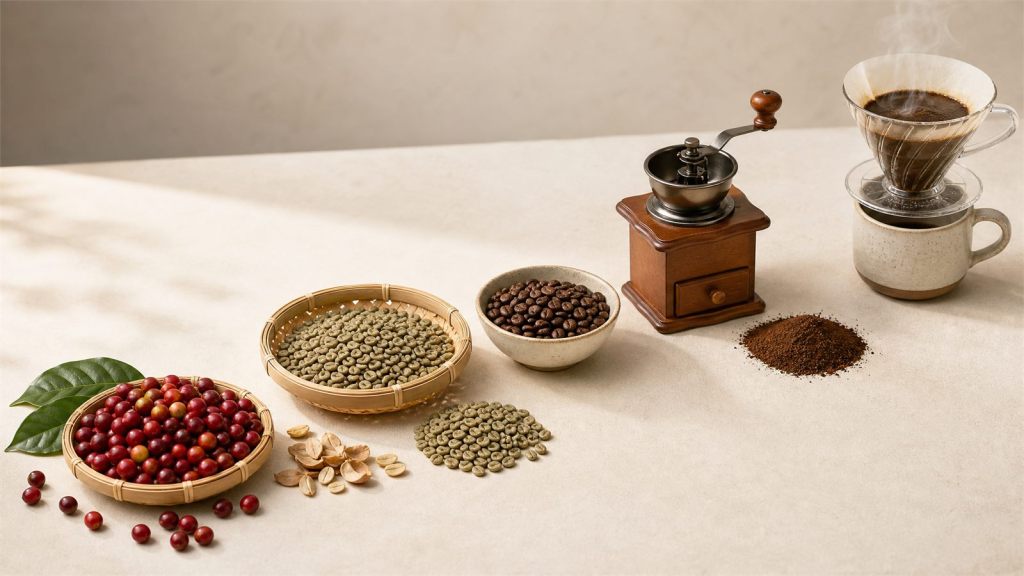
Coffee begins with the fruit of a coffee tree. Inside most coffee cherries are two seeds, which become coffee beans after processing. The cherry itself is not the same thing as the roasted coffee bean you use for brewing.
A coffee cherry generally includes several layers:
- Outer skin: The protective surface of the fruit, which changes color as the cherry ripens.
- Pulp: The fruit layer surrounding the seeds. Its sugars can influence the character of the processed coffee.
- Parchment: A protective layer around the developing seeds.
- Silver skin: A thin layer that remains close to the bean and may be loosened during roasting.
- Coffee seed: The part that is processed, roasted, ground, and brewed as coffee.
Once coffee cherries are harvested, the seeds are separated from the fruit and dried. The resulting green coffee beans are then sorted and prepared for roasting.
The Coffee Tree Life Cycle
Coffee trees are evergreen plants that can produce flowers and fruit in recurring cycles. Depending on the growing environment and cultivation practices, a single plant may show flowers, green cherries, and ripe cherries at the same time.
The health of the tree, the altitude, the climate, the soil, and the timing of harvest all affect coffee quality. Ripe cherries are typically selected for processing because their maturity contributes to a more developed flavor profile.
Where Does Coffee Come From?
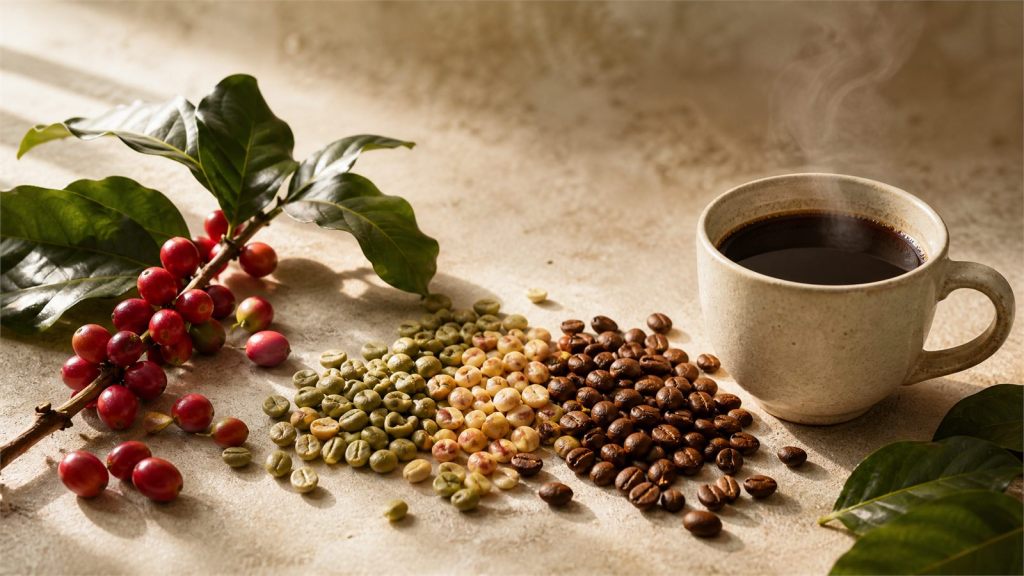
Coffee grows in tropical regions around the world. The best-known coffee-growing areas are often grouped into three broad regions:
Central and South America
Coffees from this region are often associated with balanced sweetness, clean acidity, and familiar notes such as chocolate, nuts, caramel, or fruit. Flavor varies significantly by country, farm, altitude, variety, and processing method.
Africa
African coffees are frequently recognized for expressive acidity and distinctive fruit or floral aromas. Some coffees from this region can offer bright citrus, berry, stone-fruit, or tea-like characteristics.
Asia and the Pacific
Coffees from Asia and the Pacific can show deeper body, earthy tones, spice, cocoa, or tropical fruit notes. Local climate, farming traditions, and processing choices create a wide range of flavor profiles.
Origin is an important part of a coffee’s identity, but it is not the only factor. Two coffees from the same country can taste very different when they come from different varieties, farms, elevations, harvests, or roast profiles.
Arabica vs. Robusta: What Is the Difference?
Two coffee species appear most often in the global coffee supply: Arabica and Robusta, a common name for coffee from the Coffea canephora species.
| Characteristic | Arabica | Robusta |
|---|---|---|
| Typical flavor profile | Often more aromatic, sweet, and nuanced | Often fuller-bodied, stronger, and more bitter |
| Growing environment | Commonly associated with higher elevations and milder conditions | Often performs well in warmer, lower-elevation environments |
| Bean appearance | Usually flatter and more elongated | Usually smaller and rounder |
| Caffeine | Contains caffeine; level varies by bean and preparation | Typically contains more caffeine than Arabica |
| Common use | Specialty and premium coffees, blends, and single origins | Espresso blends, instant coffee, and robust blends |
Neither species is automatically “better.” The right choice depends on the desired flavor, strength, aroma, cost, brewing method, and consumer preference. Many coffees use a blend of both to balance fragrance, body, crema, and intensity.
How Is Coffee Made?
Coffee production can be understood as a chain of transformations. Every step affects the final experience.
1. Growing and Harvesting
Coffee trees produce flowers that develop into coffee cherries. When the cherries reach maturity, they are harvested by hand, mechanically, or through a combination of methods.
Harvest timing matters. Under-ripe and over-ripe fruit can introduce unwanted flavors, while consistent maturity can support a cleaner and more balanced cup.
2. Processing the Coffee Cherries
The seeds must be separated from the fruit. Common processing approaches include:
- Washed processing: Fruit is removed before the beans are dried. This can emphasize clarity and acidity.
- Natural processing: Whole cherries are dried before the fruit is removed. This can contribute fruit-forward flavors and greater body.
- Honey or pulped-natural processing: Some fruit is removed before drying, leaving a portion of the mucilage on the bean.
Processing is not simply a technical step; it is part of the flavor design of the coffee.
3. Drying and Sorting
After processing, beans are dried to a stable condition and sorted by size, density, defects, and quality. The beans at this stage are called green coffee because they have not yet been roasted.
4. Roasting
Roasting transforms green coffee into the fragrant brown beans used for brewing. Heat triggers chemical reactions that develop roasted aromas, sweetness, body, and color.
- Light roasts may highlight acidity, floral notes, fruit, and origin character.
- Medium roasts often balance acidity, sweetness, body, and roast flavor.
- Dark roasts may emphasize deeper roasted, bitter, smoky, or cocoa-like notes.
Roast level is a useful reference, but it does not tell the whole story. Bean quality, origin, processing, roast curve, freshness, grind size, water, and brewing time all matter.
5. Grinding and Brewing
Grinding increases the surface area of coffee so water can extract soluble flavor compounds. The ideal grind depends on the brewing method.
- Coarser grinds are commonly used for immersion or longer-contact methods.
- Medium grinds are common for many drip and filter preparations.
- Finer grinds are often used for espresso or fast extraction.
Brewing is the final stage where coffee becomes a beverage. Water temperature, contact time, coffee-to-water ratio, agitation, and filtration influence the result.
What Are the Main Types of Coffee Preparation?
The same roasted coffee can taste different depending on how it is prepared.
Drip and Filter Coffee
Water passes through ground coffee and a filter. This method can produce a clean, approachable cup and is widely used at home and in offices.
Pour-Over Coffee
Pour-over brewing gives the user control over water flow, pouring pattern, and extraction time. It is popular with people who enjoy a more deliberate brewing ritual.
Espresso
Espresso uses finely ground coffee and pressure to produce a concentrated beverage. It is also the base for drinks such as lattes, cappuccinos, and Americanos.
Cold Brew
Cold brew uses cool or room-temperature water and a longer extraction period. It is often served over ice or diluted to taste.
Instant Coffee
Instant coffee is brewed coffee that has been processed into a dry form that can be reconstituted with water. Freeze-dried coffee is one method used to help preserve aroma and create a product that dissolves quickly.
Portable Coffee Formats
Modern coffee drinkers may not always have access to a complete coffee setup. Portable formats are designed for travel, commuting, outdoor activities, office use, and other situations where convenience matters.
Tap Labs explores this space through several product formats:
- CAP-TAP is designed to turn a compatible bottled-water experience into a compact coffee-brewing moment.
- Sec-Brew presents coffee in a convenient card format intended to mix with water or milk.
- Mint Fuel brings real coffee-derived caffeine into a small coffee candy format for people who want a compact way to enjoy coffee flavor and function.
These formats do not replace every traditional brewing method. Instead, they address a different need: making coffee easier to take, prepare, and enjoy throughout the day.
Why Does Coffee Taste Different?
Coffee flavor is shaped by a combination of variables rather than one single ingredient. Important factors include:
- Coffee species and variety – Different plants can produce different levels of sweetness, acidity, body, and aroma.
- Origin and growing conditions – Elevation, soil, climate, shade, and farming practices affect the bean.
- Processing method – Washed, natural, and honey processing can create distinct flavor expressions.
- Roast profile – The application of heat changes aroma, color, body, and perceived bitterness.
- Grind size – A grind that is too fine or too coarse can affect extraction balance.
- Water quality – Water makes up most of a brewed cup, so its mineral composition matters.
- Brewing method – Contact time, pressure, temperature, and filtration influence which flavors are extracted.
- Freshness and storage – Exposure to oxygen, heat, light, and moisture can reduce coffee quality over time.
This is why “good coffee” is not a single universal flavor. Some drinkers prefer bright and floral coffees, while others prefer chocolatey, smooth, bold, or low-acidity profiles.
Coffee and Convenience: Choosing the Right Format
The best coffee format depends on the situation.
| Situation | A suitable coffee format | Why it may work |
|---|---|---|
| Slow morning routine | Whole bean or ground coffee | Supports a more hands-on brewing ritual |
| Office or study session | Instant coffee or coffee card | Fast preparation with minimal equipment |
| Travel or outdoor use | Portable brewer or single-serve format | Easier to carry and prepare |
| Iced coffee occasion | Cold brew or concentrated coffee | Convenient to chill, dilute, or pour over ice |
| Small caffeine break | Coffee candy or mint format | Compact and easy to carry |
A modern coffee brand should not ask consumers to choose between flavor and convenience. Product design can make it easier to enjoy both.
How Tap Labs Thinks About Coffee
Tap Labs is focused on the space where coffee quality meets everyday mobility. Our products are built around a simple idea: coffee should adapt to the way people live.
That may mean brewing with a familiar bottle of water, mixing a compact coffee format at a desk, or carrying a small coffee candy when a full cup is not practical. The format changes, but the goal remains the same—make coffee more accessible without turning it into an artificial shortcut.
From the coffee cherry to the final sip, every detail matters: ingredient quality, processing, aroma preservation, packaging, usability, and the moment in which the consumer chooses to enjoy it.
Frequently Asked Questions About Coffee
Is a coffee bean actually a bean?
Not botanically. A coffee “bean” is the seed found inside a coffee cherry. The term “bean” is widely used because of its shape and everyday language.
What is coffee made of?
Coffee begins as the seed of a coffee plant. Brewed coffee is primarily water that has extracted soluble compounds from roasted and ground coffee beans.
What is the difference between Arabica and Robusta?
Arabica and Robusta are two commonly used coffee species. Arabica is often associated with more aromatic and nuanced flavors, while Robusta is often associated with greater body, intensity, and higher caffeine content. The actual taste depends on origin, processing, roasting, and brewing.
Is instant coffee real coffee?
Yes. Instant coffee starts with brewed coffee that is processed into a dry form. It can then be dissolved in water or another liquid for convenient preparation.
What is freeze-dried coffee?
Freeze-dried coffee is a type of instant coffee made by freezing brewed coffee and removing water under controlled conditions. The process is designed to produce a dry, soluble coffee product while helping retain desirable aroma characteristics.
Does darker roast coffee always have more caffeine?
Not necessarily. Caffeine content depends on the coffee species, bean amount, serving size, preparation method, and other variables. Roast color alone is not a reliable way to determine caffeine content.
What coffee format is best for travel?
The best option depends on your equipment, water access, and preferred taste. Portable brewers, single-serve coffee, instant coffee cards, and other compact formats can be useful when a traditional coffee maker is not available.
How should coffee be stored?
Coffee should generally be protected from oxygen, moisture, heat, and light. An airtight package kept in a cool, dry place can help preserve flavor and aroma.